Updated October 7, 2026
Penseum Alternatives: 5 Options Compared, Plus a Head-to-Head Test
By Keanu, Founder of Quizzify · Updated October 7, 2026 · All prices in USD
Penseum is one of the most ambitious AI study apps around. Paste in your notes and it builds a whole course: a study guide, an exam, flashcards, a podcast, and a voice tutor that talks you through problems on a shared canvas.
The catch is the free plan. My test account got one exam, a five-minute tutor preview and six flashcards before the Pro prompts started. Pro costs $29.99 a month or $99 a year on the web ($99.99 a year in the App Store).
If you mainly use Penseum for quizzes and flashcards, you can get those for less, or for free. Below are five alternatives and who each one suits. Then I'll show you what happened when I gave Penseum and Quizzify the same page of lecture notes and made the same mistake in both.
Quick picks
| If you want... | Try |
|---|---|
| Quizzes from your own notes, with feedback and a review schedule | Quizzify |
| Free flashcards you fully control, even offline | Anki |
| Your notes and flashcards in one place | RemNote |
| Free Quizlet-style study modes | Knowt |
| Ready-made sets from other students | Quizlet |
| A tutor that talks you through problems | Stay with Penseum |
Try Quizzify free with your own notes →
Why look for a Penseum alternative?
- You've hit the free limits. One exam and a five-minute tutor preview go fast. Several paid options below work out to a third of Penseum's monthly price or less, and some tools are free.
- You rarely use the tutor. The tutor is Penseum's standout feature, and Pro expands tutor time and exams. If you mainly make quizzes and flashcards, you'd be paying for something you don't use.
- You want to see what's due today. Penseum says it schedules spaced reviews, but I couldn't find a review schedule in the free web app (details below). Quizzify, Anki, RemNote and Knowt all show you what to review and when.
- You want a different kind of tool: full control over your cards (Anki), notes and cards in one place (RemNote), or a huge library of shared sets (Quizlet).
Penseum alternatives compared
| Tool | Makes questions from your files | Schedules your reviews | Free plan |
|---|---|---|---|
| Quizzify | Yes: multiple choice, written answer, true/false, matching, case study | Yes, per question, from your scores | 100 credits a week for AI features |
| Penseum | Yes: quizzes, mock exams, flashcards, guides, mind maps | Advertised; not found in the free web app | In my test: 1 exam, a 5-minute tutor preview, 1 podcast, 6 flashcards |
| Anki | No (add-ons can) | Yes, based on your own recall ratings | Free on desktop, web and Android |
| RemNote | Yes, within AI credit limits | Yes, plus an exam scheduler | Unlimited notes and cards; 250 AI credits a month |
| Knowt | Limited on the free plan | Yes, in Spaced Repetition mode | Unlimited sets and study modes; 1 AI summary a month |
| Quizlet | Practice tests from your notes, capped by plan | Learn mode adapts what you practise | Flashcards; limited premium modes |
Prices
| Tool | Paid plans |
|---|---|
| Quizzify | $9.99/month · $29.99 for a four-month semester pass (one payment) · $59.99/year · $169.99 lifetime |
| Penseum | $29.99/month or $99/year ($99.99/year in the App Store) |
| Anki | Free, except the official iOS app (one-time purchase) |
| RemNote | Pro $96/year; Pro with AI $216/year ($8 and $18 a month, billed yearly) |
| Knowt | Ultra $24.99/month or $149.99/year |
| Quizlet | Plus $7.99/month or $35.99/year · Plus Unlimited $9.99/month or $44.99/year · Family $83.99/year for up to 5 accounts (limited-time) |
New Quizzify users currently get their first semester pass for $26.99 or their first year for $47.99 (see pricing). The semester pass is a one-time payment; monthly and yearly plans renew. Competitor prices are as listed on their official pages, and taxes, currency and offers can differ at checkout.
Head-to-head: same notes, same mistake
Feature lists only tell you so much. So I gave both tools one page of notes on simple DC circuits (download them and try it yourself) and made the same mistake in each.
Ohm's law is V = I × R: voltage equals current times resistance. A 6-ohm resistor connected to a 12-volt supply carries 2 amperes. Two 6-ohm resistors in series have a total resistance of 12 ohms, so the same 12-volt supply produces 1 ampere.
The mistake: dividing instead of multiplying. In Quizzify I typed "Voltage equals current divided by resistance." Penseum's exam was multiple choice, so I picked V = I / R. It's the same misunderstanding in two formats, and that difference matters later.
Penseum: from notes to a full course in about 30 seconds
Penseum was impressive from the start. About 30 seconds after I pasted the notes, I had a course called DC Circuit Basics and a seven-question exam. All seven were multiple choice, and every one came straight from the notes: Ohm's law, series and parallel resistance, power and current.
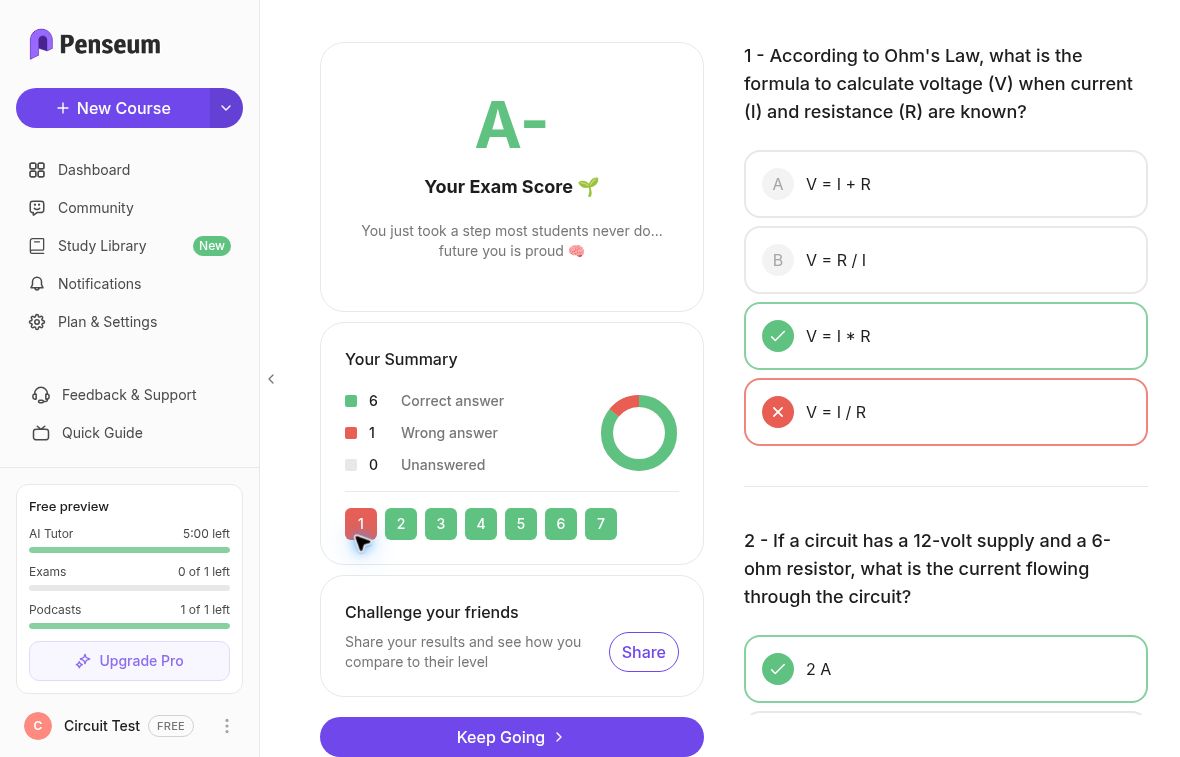
The exam doesn't tell you how you're doing as you go. Only at the end did it mark V = I / R wrong in red, show V = I × R in green, and give me an A− for six out of seven. The results screen didn't explain the mistake.
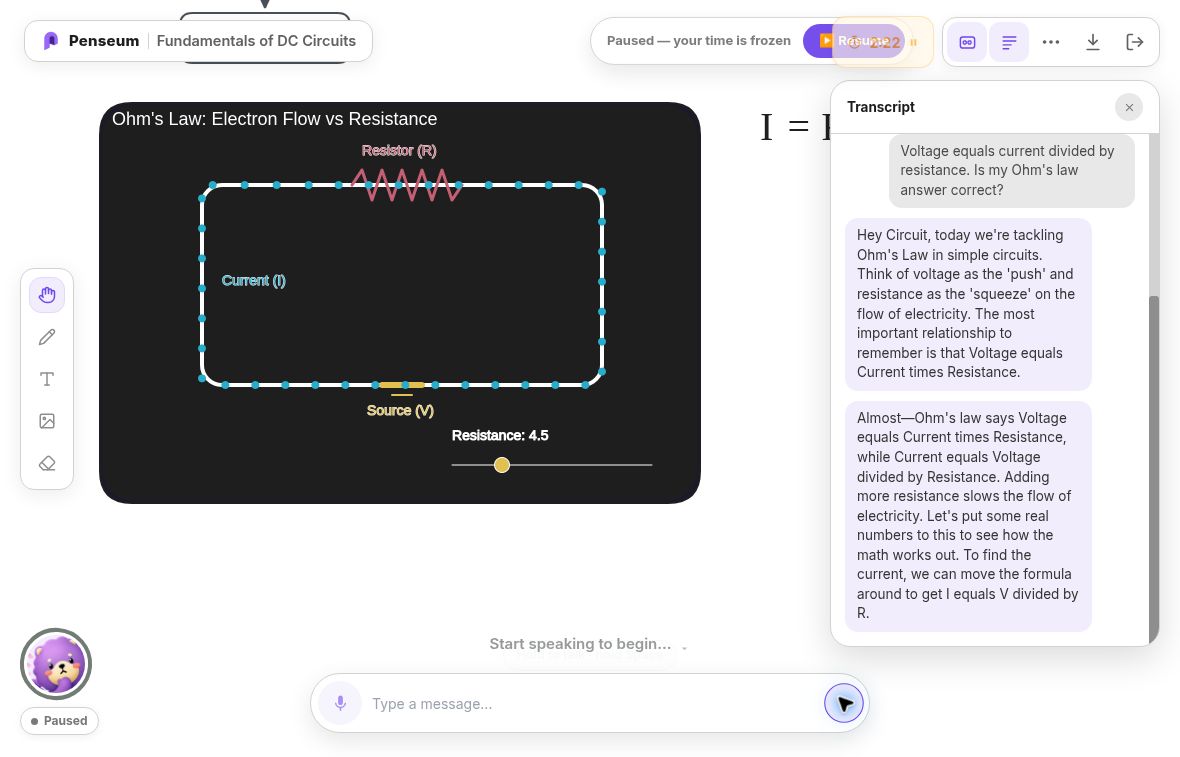
To find out why, I asked the AI Tutor: "Voltage equals current divided by resistance. Is my Ohm's law answer correct?" Its answer was clear. Voltage equals current times resistance; it's current that equals voltage divided by resistance. The answer appeared next to an interactive circuit canvas. That combination made the tutor the standout part of my Penseum test.
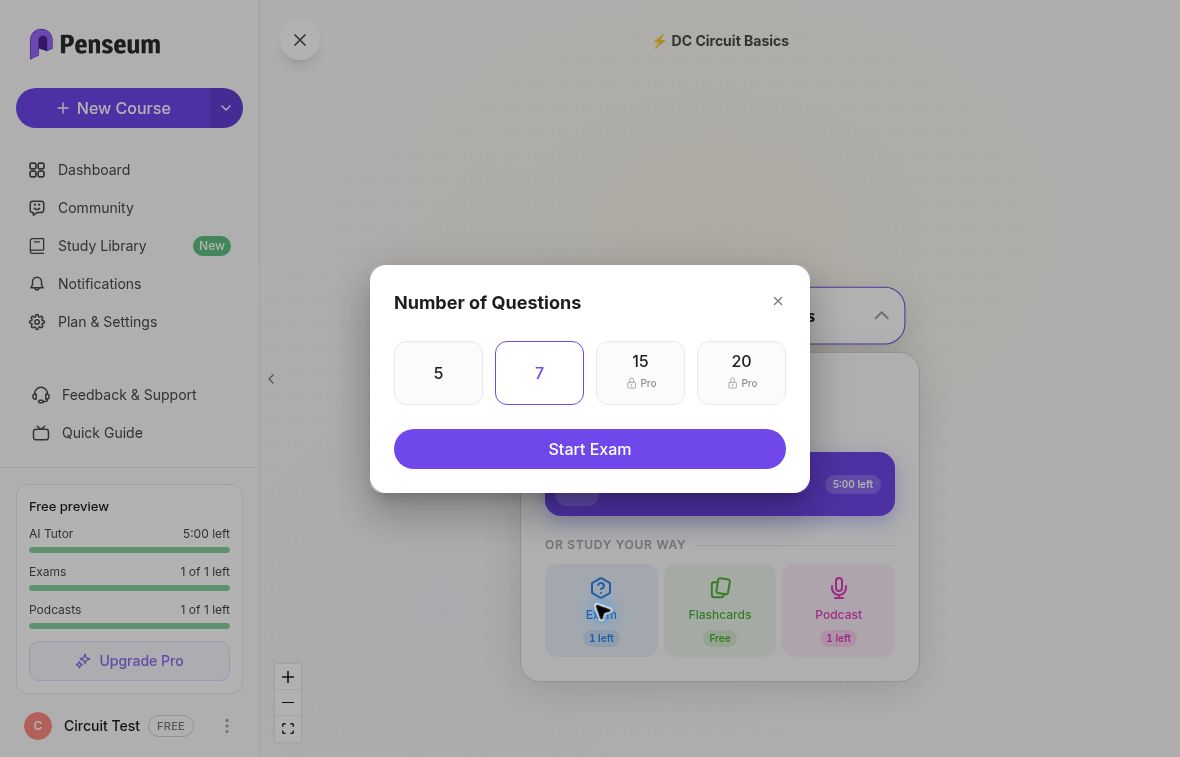
Then I hit the limits. The free account came with one exam, a five-minute tutor preview and one podcast, and after my exam the counter read 0 of 1 left. Five- and seven-question exams were free; 15 and 20 questions needed Pro. The flashcard set had six cards with flip, hint and shuffle, and the last card offered Generate More with Pro.
The one thing I couldn't find was a review schedule. Penseum says it schedules spaced reviews automatically. I finished the flashcards and checked the dashboard and settings, but found no due dates, review intervals or review queue. I couldn't confirm whether scheduling requires Pro or another version of the app.
Where Penseum won: organisation. It turned one page of notes into a named course with a tutor, exam, flashcards and a podcast in one place. If you want an AI to set up your whole course, that broader workspace is a strength.
That breadth comes at a cost. In my free account, the tutor, exam and podcast each had a small allowance, and I'd used up the exam allowance after one try. Quizzify does less on purpose. It's built around one loop: answer a question from memory, see what you got wrong, and come back when it's due. It does fewer things but it does them well, and it's built to get you back for the next review.
Quizzify: built around the next review
1. Upload the notes. Open Create, choose From Files, and add the file. PDFs, Word documents, PowerPoint slides, text and HTML files, and photos of pages (PNG/JPG) all work, or you can paste text. From these notes it made four questions, two written-answer and two multiple choice, covering Ohm's law, the power formula, current in series, and resistance in parallel. You can edit or delete any question that doesn't fit.
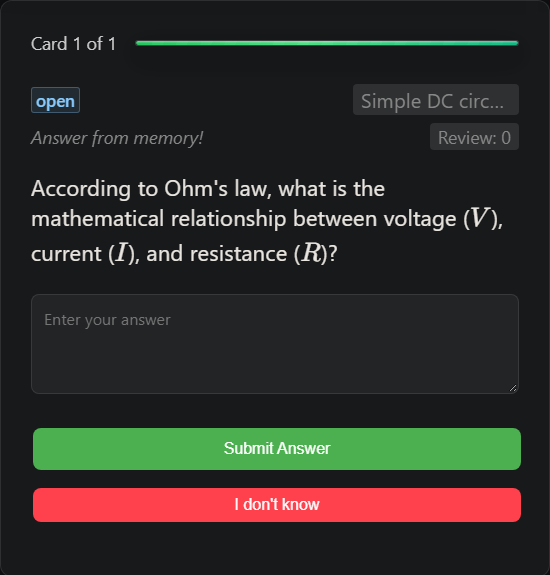
2. Answer from memory. For this question, there were no options to pick from, so I had to write the formula myself. That's harder than picking from a list: you have to pull the answer out of memory instead of recognising it among the options. It's practice at producing the answer yourself, as you would in a written exam.
The research backs this up, with one condition. In a 2007 study by Kang, McDermott and Roediger, students who answered short-answer questions and then saw the correct answer remembered the most three days later. Without that feedback, multiple choice performed better. So both parts matter: write the answer yourself, then check it against the correct answer.
Multiple choice still helps, and Quizzify uses both formats. Written answers add practice at producing an explanation or calculation without answer options to guide you.
That's what happened here. Quizzify gave my answer 40% and explained the mistake immediately: Ohm's law multiplies, it doesn't divide. Then it scheduled the question for the next day.
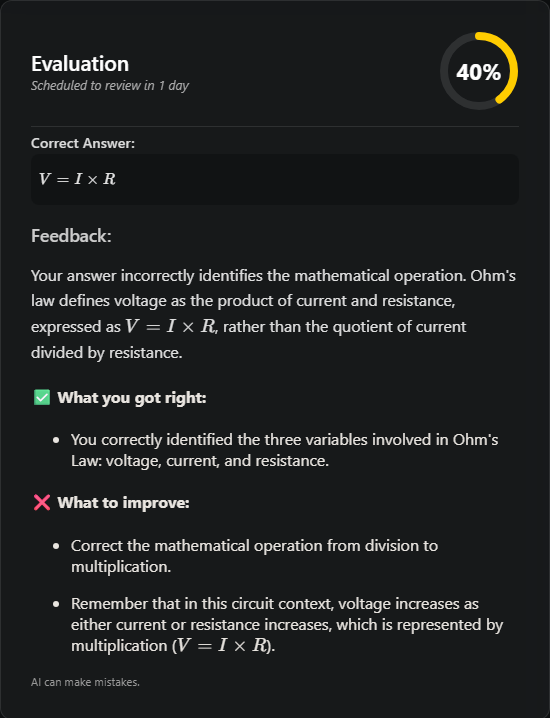
Written answers are graded by AI; multiple-choice, true/false and matching answers are checked against the answer key. The grader is good but not perfect, so if feedback looks wrong, trust your notes.
3. Come back when it's due. Every question gets its own schedule based on your score. Score below 60% and it comes back the next day. After your first good answer it waits three days, then six, then longer as you keep getting it right. Each day, Start Reviews on the dashboard pulls together everything due across your decks.
To skip the wait, I moved the test account's clock forward 25 hours. The question was back, marked Review: 1:
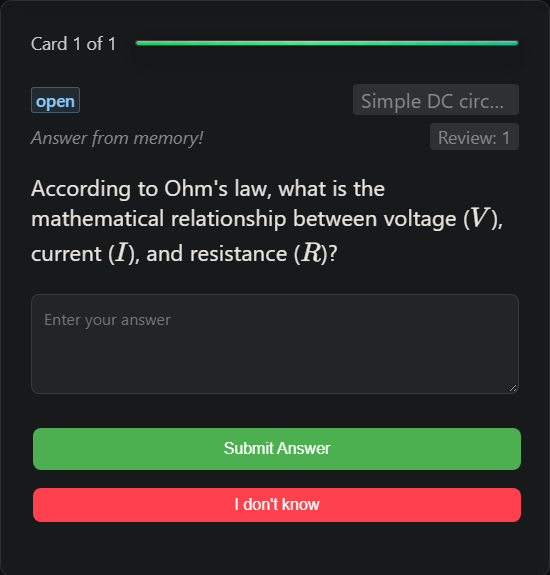
Why a day later? Spacing out reviews is one of the best-supported findings in learning research; one review pooled 317 experiments. Our own data shows the same pattern. Across 192,728 reviews by 4,538 Quizzify users, a second attempt the next day improved scores by 27.8 points on average, versus 15.7 for a second attempt the same day. Those are in-app scores, not grades, but they line up with the research.
The verdict
| Penseum | Quizzify | |
|---|---|---|
| Questions from the notes | 7 multiple choice, all on topic | 4 (2 written, 2 multiple choice), all on topic |
| How I answered | Picked V = I / R from a list | Typed the formula from memory |
| Feedback on the mistake | Right/wrong at the end; the separate tutor explained it | Straight away: 40%, with the mistake explained |
| When to review | Advertised; not found in the free web app | Scheduled for the next day |
| Organised into | A course with tutor, exam, flashcards and podcast | A deck of questions |
| Free plan after this test | The one free exam was used up | About a third of the 100 weekly credits used |
Penseum was better at the first session in this test. It was fast, it organised everything for me, and its tutor explained the mistake clearly. Quizzify was better at what came after: it made me write the answer instead of picking it, explained the mistake straight away, and scheduled the question for the next day. Writing an answer and then seeing the correction matches the approach that performed best in the study above.
If you'll use the tutor a lot, Penseum Pro may be worth $29.99 a month. If you mainly want practice and a review routine, that's what Quizzify is built for.
Turn your lecture notes into a practice quiz, free →
The alternatives in more detail
1. Quizzify: practice questions with feedback and a review schedule
You've seen it in action. Quizzify is for students who already have the material (slides, notes, textbook photos) and want to spend their study time answering questions instead of writing them. Folders, progress tracking and a Socratic tutor round it out.
- Choose it if: you want questions from your own notes, feedback on written answers, and an app that tells you what to review each day.
- Look elsewhere if: you want a live voice tutor, a big library of shared decks, or fully offline study. Generating, grading and tutoring need an internet connection.
- Free plan: 100 credits a week. A quiz costs 30 credits, grading a written answer costs 1, and a tutor message costs 3. Start with one lecture so you have credits left to try the grading.
- Paid plans: $9.99/month, $29.99 for a four-month semester pass, or $59.99/year, with 10,000 credits a week under fair use.
2. Anki: free flashcards you fully control
Anki is the free, open-source flashcard app a lot of med students swear by. You write or import cards, try to recall each answer, then rate how well you remembered it, and Anki schedules the next review from that rating. The settings and add-ons go deep: great if you like tinkering, a lot if you don't.
- Choose it if: you're building a deck to keep for years, there's already a good shared deck for your course, or you need to study offline.
- Look elsewhere if: you want questions made from your lecture files without setup. Add-ons can do it, but you'll have to configure them.
- Price: free on desktop, the web (AnkiWeb) and Android. The official iOS app is a one-time purchase.
Full comparison: Quizzify vs Anki →
3. RemNote: notes and flashcards in one place
RemNote lets you turn parts of your notes into flashcards as you write, then reviews those cards with spaced repetition. It also has AI tools and an exam scheduler.
- Choose it if: you want your notes, cards and PDFs connected in one workspace.
- Look elsewhere if: you just want to upload a file and start a quiz without building a note system. Compare the AI allowances before paying, because the two paid plans differ a lot.
- Free plan: unlimited notes and flashcards, three annotated documents, and 250 AI credits a month.
- Price: Pro is $96/year and Pro with AI is $216/year ($8 and $18 a month, billed yearly).
4. Knowt: free Quizlet-style study modes
Knowt's free plan is generous for flashcards: unlimited sets and core study modes on your own sets, including Learn, Practice Test, Match and Spaced Repetition. The limits are on the AI tools; the free plan includes one AI summary a month.
- Choose it if: you want free flashcard drilling with several ways to practise the same set.
- Look elsewhere if: you want AI to work through your lecture files regularly without paying.
- Price: Ultra is $24.99/month or $149.99/year. It removes ads and adds AI file tools and Call Kai, which quizzes you aloud on your flashcards. Call Kai on your own sets needs Ultra; sets and notes shared by a teacher in a class are free.
5. Quizlet: millions of shared study sets
Quizlet's biggest strength is everyone else's work: search for your course and there's often a set already. You can also make your own and practise with flashcards, Learn mode and AI practice tests from your notes.
- Choose it if: your classmates or teacher already have good sets for your course.
- Look elsewhere if: you want premium study modes without paying. Also check shared sets against your syllabus, since other students wrote them.
- Price: Plus ($7.99/month or $35.99/year) includes 3 practice tests, 3 textbook solutions or Q&As, and 20 Learn rounds a month. Plus Unlimited ($9.99/month or $44.99/year) removes the practice-test and Learn caps. Yearly plans are billed upfront, and practice tests depend on your language, age and region.
The fastest way to decide
Don't pick from a table. Take one lecture you have to learn this week and run it through the two tools that sound closest to what you need. Then ask two questions: did the questions cover what your exam will ask, and did the app get you to come back the next day? Pick the one that does both.
FAQ
Is Penseum free?
Yes, with tight limits. Penseum's study-guide, quiz and flashcard tools are free, and its blog describes free voice-tutor access. My free account got a five-minute tutor preview, one exam, one podcast and six flashcards. Pro ($29.99/month or $99/year) expands tutor time and exams. Limits may vary, so check your own account.
What's the best free alternative to Penseum?
For flashcards, Anki and Knowt are both free. For practice quizzes made from your own notes, Quizzify's free plan gives you 100 credits a week: enough for three quizzes, with the rest for grading written answers.
Is Penseum worth paying for?
If you'll use the voice tutor every week, it might be. Its shared canvas and clear explanation were the highlights of my test. If you mostly use Penseum for quizzes and flashcards, a free plan or a cheaper paid plan will probably do the job.
Does Penseum use spaced repetition?
Penseum advertises automatic spaced reviews, but I couldn't find a schedule in the free web app. See the head-to-head test above for what I checked.
Can Quizzify grade written answers?
Yes. AI scores each written answer and explains what you got right and what to fix. It's good at spotting partial understanding but isn't perfect, so check anything odd against your notes.
Have a lecture to learn this week? Make a free Quizzify quiz from it →
Related: Studley AI alternatives · Quizzify vs Anki · How to use Quizzify for exams · What 192,728 reviews taught us
Related Resources
Keep studying with practical guides and plan details.